MENU
  • search
  • en
slider-14-130-2022-08-13.jpg
icons/snippet/Banner MUSCLES (RUS).webp
icons/snippet/Banner PRP (RUS).webp
HEAD JOINTS
CORRECTION
NECK TREATMENT
TREATMENT OF
MUSCLE FIBROSIS
NECK TREATMENT
PROLO & PRP
FOR LIGAMENTS AND JOINTS
NECK TREATMENT
View all
icons/snippet/Баннер RU.jpg
HEAD JOINTS CORRECTION NECK TREATMENT
icons/snippet/Banner MUSCLES (RUS).webp
TREATMENT OF MUSCLE FIBROSIS NECK TREATMENT
icons/snippet/Banner PRP (RUS).webp
PROLO & PRP FOR LIGAMENTS AND JOINTS NECK TREATMENT

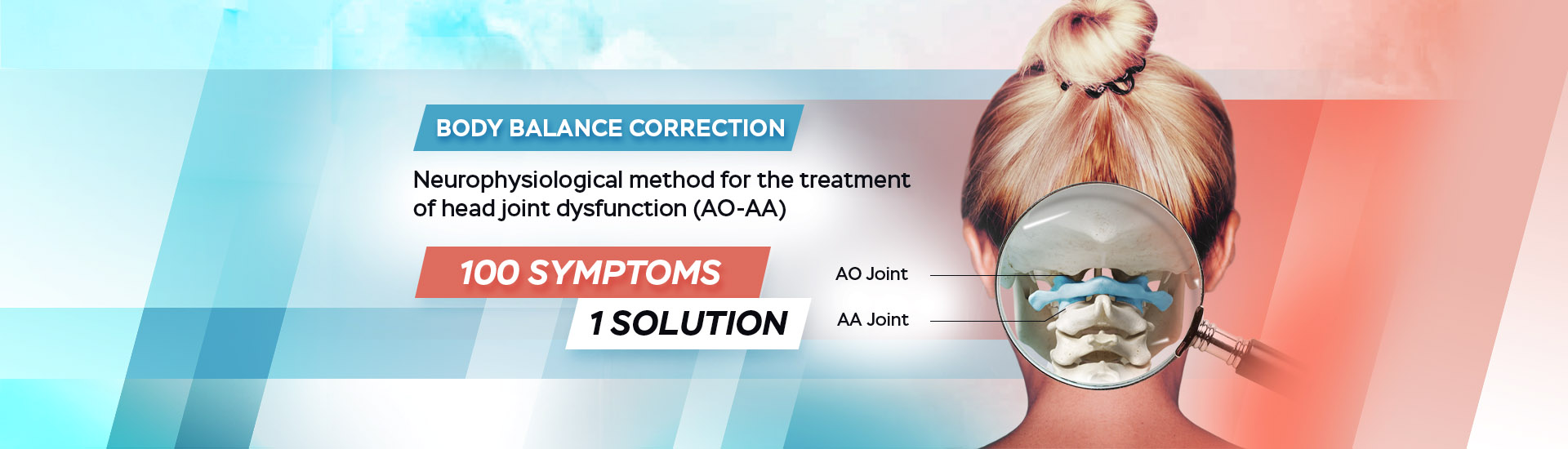
Head joints dysfunction

Head joints dysfunctionHead joints dysfunction
Watch this short video about neck joint dysfunctions. You will learn that disorders in the area where the head joins the neck can cause a huge number of neurological symptoms and are the main cause of osteochondrosis, as well as the main culprit behind most biomechanical distortions, tension and pain in the spine.
If your treatment so far has been aimed at suppressing pain and discomfort, then our method of treating craniovertebral dysfunction will help you resolve the root cause of cervical osteochondrosis, of spinal disorders, which will thereby relieve your symptoms or even completely eliminate most of your existing problems.

Where does the spine begin? Or WHERE is the main cause of the biomechanical breakdown

Let us look at 2 examples: in the first case, the patient has a pronounced head joints dysfunction. The joints are locked, and the first vertebra, the “Atlas”, is displaced and rotated due to the asymmetric tone of the muscles that control it. In the second case, after the “Correction” has been performed, the first vertebra takes the correct position, the muscles have a symmetric tone and the joints work normally.
Head joints dysfunction

Asymmetric

muscle tension

Symmetric

muscle tension

The dysfunction can arise as a result of birth trauma, head injuries and various other “stressful situations for the head and neck”, after which there develops under the skull an asymmetric tension of the paired muscles. A situation where one “twin muscle” pulls harder than the other leads to rotation of the vertebrae under the skull and a systemic “twisting” of the spine along its entire length, all the way down to the sacrum.
Neurologists know these pathological conditions as obliquus capitis superior syndrome, obliquus capitis inferior syndrome and so on.
Head joints dysfunction

Rotational subluxation
of the cervical vertebrae

Correct
alignment

One of the tasks of the head joints is to balance the weight of the skull (about 5 kilograms) and distribute it evenly along the axis of the spine.
If the head joints work incorrectly due to muscle syndromes, this can lead to a discoordination of the centers of gravity of the head and body and, accordingly, to a collapse and biomechanical breakdown of the spine.
Head joints dysfunction

 Biomechanical collapse

 Body balance

Displacement of the head relative to the vertical axis and an asymmetric load on the first vertebrae and joints force the spine to distort in an attempt to find balance. This leads to a systemic curvature and decompensations in the body.
As you can see, scoliosis, back pain and many other symptoms of osteochondrosis may have completely different causes from what you are used to thinking. The balance of the body depends directly on the condition of the cervical spine. This is the foundation of everything.

What does it look like in real people?

Head joints dysfunction

Imbalance​

Balance​

The first image shows asymmetric tone (syndromes) of the paired muscles, due to which the alignment of the cervical vertebrae relative to the base of the skull is disturbed. Comparison with the norm.
Head joints dysfunction
Dysfunction in the neck has a complex effect on the health of the spine, the patient’s posture and the ability to keep the back straight. The photo was taken before the procedure and three months after it.
Head joints dysfunction

Different leg length

Equal leg length

When the patient is lying on a massage table, the specialist pulls the patient’s legs with equal force, holding them at the Achilles tendons. As a rule, when there are dysfunctions in the head joints and a picture of biomechanical breakdown in the spine, the patient’s legs stretch out asymmetrically and have different lengths, because of a pelvic tilt and asymmetric tone of the myofascial chains.
After the craniovertebral dysfunction is eliminated, symmetric tension of the myofascial trains along the entire body is restored. As a result, the pelvis and legs become level. The muscles work synchronously. The effect is lasting. The photo was taken before and immediately after the procedure.
Head joints dysfunction

Different flexibility when

bending the legs, a twist in the pelvis

Equal flexibility,
no distortions

When the legs are bent at the knees with the same pressing force, the patient’s legs may spring back at different points. As a rule, one leg bends deeper and the other more stiffly. At the same time, patients often experience very unpleasant sensations in the lower back. This indicates the presence of a spiral in the spine and a rotational twist in the pelvis caused by dysfunction and subluxation of the head joints.
In other words, rotation of the cervical vertebrae triggers a pathological process of twisting the spine into a spiral along its entire length. After the functions of the head joints have been restored, the spiral is no longer diagnosed, and the patient reports a significant improvement in sensations in the lower back. The photos were taken before and immediately after the procedure.
Head joints dysfunction
Turning the head left and right before and after the procedure
Very often a person does not even suspect that their head turns better to one side and worse to the other. But this is one of the most important and visible signs of locked head joints.
After the correction, turning the head left and right and moving it up and down improve. The patient reports that the head feels lighter on the shoulders than usual, as if it “weighs less”. Tension and pain leave the muscles of the shoulder girdle, which is checked with tests in every patient. Afterwards there is no longer an urge to rest the head on the hand. The effect is stable at follow-up checks after several months or several years.
All this indicates that the biomechanical balance has been restored. When the head joints work through their full range of motion and the muscles no longer displace the skull, the weight of the head is correctly distributed along the axis of the entire spine. As a result, muscle overload and tension go away. Compensations and trigger knots dissolve BY THEMSELVES. The pain recedes.
Our experience – more than 10,000 patients. Each of them is living proof of the significant influence of the craniovertebral region on the balance of the whole body.

Are your complaints really of psychosomatic origin?

Head joints dysfunction

How many patients have been prescribed antidepressants by their doctors, or even referred to a psychiatrist for a consultation, being told that their problems are “imaginary” and that they “obviously” have a psychosomatic origin?

And a person suffers from pain for a long time, while specialists keep saying that there is no reason for it.

Since the craniovertebral region still remains a blind spot in medicine, it is quite likely that your doctor simply does not know – and therefore does not tell you that impaired function of the head joints can become the cause of most of your symptoms.

Posture disorders, problems and tension in the musculoskeletal system, headaches, migraines, numbness in the hands, dizziness, fibromyalgia and many other diseases are just the tip of the iceberg.

How does it work in practice?

Head joints dysfunction

The Atlas (Lat. Atlas, C1) is the first cervical vertebra, which carries the head and forms the atlanto-occipital joint (Lat. Articulatio atlantooccipitalis).

The Atlas, connecting with the Axis (Lat. Axis, C2) (the second vertebra), forms the median and lateral atlanto-axial joints (Lat. Articulatio atlanto-axialis mediana et lateralis).

In total, three head joints are formed, which play the main role in the balance of the head and body and in the health of the entire spine.

Disorders in this area can have a “domino” effect, affecting the musculoskeletal, circulatory and nervous systems and creating imbalances and dysfunctions in various parts of the body. Over time, these disorders can turn into serious health problems.

The body is no longer able to function as it could and should. The quality of life is seriously undermined, yet even so doctors often cannot establish a clear cause, and patients go on being ill.

Head joints dysfunction
Many diseases and illnesses of the body that at first glance seem unrelated to each other have one common “root of evil”.
Because of head joints dysfunction, the full connection between the head and the body deteriorates.
This leads to numerous disorders of the nervous system, such as vegetative-vascular dystonia, headaches, sleep disorders, panic attacks, hyperactivity and developmental delay in children, nervous disorders, fatigue, irritability, high blood pressure, dizziness, etc.
Because of head joints dysfunction, the skull becomes displaced. If the photographer corrects your position when you have a photo taken for your documents, there is a displacement. Being unable to keep the head and shoulders level in a relaxed position is the main sign of the problem. If your head turns to one side worse and with more difficulty than to the other, the subluxation is rotational.
Since the head is displaced, the body begins to compensate for the tilt of the skull by curving the spine. This is how scoliosis develops: uneven shoulders, shoulder blades and rib cage, a stoop, hyperkyphosis, pelvic curvature and a difference in leg length. The body adapts to the displacement of the head ON ITS OWN.
No pain does not mean that everything is fine. The body gets used to it. The older the person, the higher the risk of complications. Treatment should not be put off.
The curvature causes excessive muscle tension, which leads to impaired microcirculation in the spine and early osteochondrosis (herniations, protrusions, arthritis, arthrosis, joint diseases and joint pain, discomfort and pulling sensations in the body).
As a result of a subluxation of the head joints, the symmetry of the skull may suffer and the bite may become disturbed. Crooked and uneven teeth are a 100% sign of deformation of the skull bones, a disturbed volume of the dental arches and excessive muscle tension in the occipital part of the neck.
Head joints dysfunction
9 out of 10 people with neurological disorders and symptoms of osteochondrosis have a hidden disorder and displacement of the head joints without even suspecting that it is the main cause of the general deterioration of their health.

Head joints dysfunction: the hidden cause of many ailments

Thanks to the large number of patients (more than 10 thousand people) who have undergone correction of craniovertebral dysfunction using the original method of Andrei Popravka Body Balance, and on the basis of the collected data – both medical diagnostics and doctors’ observations and subjective patient feedback – a list has been compiled of the most common complaints and symptoms for which relief or even complete recovery can be achieved after the “Correction”.
Note: 
It would be wrong to regard the “Body Balance” method as a miracle curecapable of solving all problems. On the contrary, the aim of the “Body Balance Correction” is to eliminate the cause of the biomechanical breakdown of the body, which in turn draws on the body’s capacity for self-regulation, improvement of microcirculation and self-restoration.
Head joints dysfunction
  • cervical osteochondrosis
  • headache / cephalgia
  • migraine
  • dizziness, unsteadiness, swaying
  • Ménière’s disease
  • visual impairment, eye inflammation
  • buzzing, ringing in the ears, noise in the ears
  • middle ear inflammation
  • trigeminal neuralgia
  • jaw pain, jaw clicking
  • chronic sinusitis
  • limited or painful rotation / bending of the head
  • neck tension and pain
  • stiff neck muscles
  • torticollis, spasmodic torticollis
  • shoulder pain, one shoulder higher than the other
  • paresthesia / numbness in the hands / pins and needles
  • recurrent tendinitis
  • tennis elbow
  • carpal tunnel syndrome
  • high muscle tension
  • muscle pain (fibromyalgia)
  • back tension and pain
  • functional scoliosis
  • lumbago
  • intervertebral disc protrusion
  • intervertebral disc herniation
  • compression (squeezing) of the spinal nerves
  • asymmetry or curvature of the pelvis
  • arthritis (if caused by poor posture)
  • pain in sacroiliac dysfunction
  • sciatica, inflammation of the sciatic nerve
  • radiculitis, radiculopathy
  • hip joint pain
  • difference in leg length
  • pain in the legs, knees or feet
  • valgus and varus deformities
  • chronically cold hands and feet
  • tachycardia – hypertension – low blood pressure
  • increased stomach acidity
  • gastroesophageal reflux disease
  • sudden vasovagal syncope
  • depression (if it began as a result of chronic tension and pain)
  • insomnia, sleep disorders
  • prolonged shallow sleep
  • chronic fatigue syndrome
  • learning difficulties – dyslexia (difficulty with reading or writing)
  • delayed speech development in children
  • epilepsy
  • cracking and pain in the knee joints
In most cases, these pathological conditions are actually symptoms of locked head joints

Our patients’ testimonials

Our patients’ testimonialsHead joints dysfunction
Turn on subtitles if the video is in a foreign language
Our patients’ testimonialsHead joints dysfunction
Turn on subtitles if the video is in a foreign language

Causes of the disorders

Head joints dysfunction
Neck stretching during childbirth
Birth trauma is the main cause of displacement and rotation of the cervical vertebrae relative to the occipital bone of the skull. A slight, even the most insignificant stretching of the neck of an infant leads to an asymmetric and prolonged protective muscle spasm in the occipital region, which consequently leads to displacement of the vertebrae and impaired function of the head joints. As a result of the trauma, the child cannot hold its head up on its own for a long time after birth, sometimes even for more than 2–3 months.
Giving birth lying on the back
Because of the unnatural position on the back, the pelvis opens less well, and the woman has to make much more effort, pushing the baby upwards. Excessively intense pushing and a longer labor have a negative effect on the baby’s spine. The skull and, in particular, the cervical vertebrae are compressed as the baby passes through the birth canal.
Longer duration of labor
According to studies, women giving birth on their backs undergo episiotomy more often than women giving birth in an upright position. In addition, it has also been proven that births on the back last longer (on average by 23 minutes in first-time mothers and by 13 minutes in women giving birth again).
Head joints dysfunction
Head and neck injuries throughout life
Childhood injuries at an age one does not remember, falls and blows to the head, scuffles at school, fights, long-term martial arts training, sports injuries, whiplash injury in a car accident, diving injury, sharp jerks and cracking of the neck during a massage session, the urge to crack one’s own neck, and traumatic brain injuries can worsen the condition of the head joints.
Head joints dysfunction
Deviations are usually considered “genetic”
Traditional medicine holds that possible deviations in the atlanto-occipital joint (except in cases of serious injury) are determined by genetics and do not need correction. As a result, the problem is practically never diagnosed, while even a slight displacement in the joint can lead to very serious pathological changes throughout the body.
Head joints dysfunction
Examinations do not focus on the craniovertebral region
Spiral computed tomography (3D CT) makes it possible to determine very precisely the degree of displacement and the misalignment of the vertebrae, but only if the radiologist focuses on this area. In most cases, the rotation goes unnoticed, again because of the beliefs of traditional medicine.
Head joints dysfunction
Unsuitable diagnostic methods
The downside of all mass methods of spinal examination is that it is practically impossible to identify head joints dysfunction or rotation of the Atlas and Axis with a conventional 2D X-ray examination.
Head joints dysfunction
Lack of effective treatment methods
Traditional medicine does not offer methods of biomechanical treatment. To eliminate the symptoms that arise from displacements of the cervical vertebrae, pharmacology is most often used.
Attempts to correct a curved pelvis, relieve spasm of the paravertebral muscles or reduce pain in the spine with classical rehabilitation or physiotherapy without solving the problem at its root and without performing a RESTART of the nervous system, namely the reticular formation, are doomed to low effectiveness; the improvements from such procedures often last only a short time, and the previous pain quickly returns.
To date, the technology of full-fledged neurophysiological treatment of craniovertebral dysfunction is available only to the specialists of the BODY BALANCE organization.
Only after the “BODY BALANCE Correction” does the effectiveness of subsequent physiotherapy methods increase significantly, and thanks to a comprehensive approach it is possible to restore the patient very quickly and, most importantly, to relieve them of their problems for a long period of time, which has been repeatedly confirmed by our colleagues – neurologists, rehabilitation specialists and physiotherapists with whom we work closely.

Is your correction dangerous?

Head joints dysfunction

Many doctors and patients consider any intervention in the neck dangerous.


Yes, this statement is true, but only in cases of sharp and rough manipulations of the neck, when a person is asked to “relax and trust”.
The BODY BALANCE organization has nothing in common with such methods of forcefully “setting” vertebrae. We use completely different, absolutely safe principles of interacting with your muscles.
This is NOT manual therapy, NOT bonesetting, NOT massage and NOT osteopathy. No cracking, sudden movements or stretching of the neck are performed. Arteries, cartilage and vertebrae are not affected.

“Brain Hacking”, or the neurophysiological technology of the “Body Balance Correction” method

Head joints dysfunction
The “Body Balance Correction” method is a way of neurophysiological restoration of the functions of the nervous system through stimulation and fatigue of the nerve endings in the muscles.
The technology makes it possible to carry out a complete reset and restart of the entire reticular formation (the human neuromuscular framework) and to overcome the “muscle memory” of any muscle in the body.
Simply put, the method restores the correct control of the muscles exercised by the brain. It is for this reason that the effect obtained is lasting and is maintained throughout life, and the changes after the procedure cover the entire body. The body recovers from misalignments, compensations and distortions in one go.
In addition to normalizing balance and tension, microcirculation is restored in the paired muscles of the head joints, and fibrosis is eliminated.
Head joints dysfunction
Specialists have been struggling to solve the problem of craniovertebral dysfunction for several decades, but there is still no mass solution. Why is that? We can give the answer.
Craniovertebral dysfunction is a dysfunction of a neurogenic nature that can be eliminated exclusively by neurophysiological means. We have the technologies for this.

How is the correction performed?

HEAD JOINT CORRECTION – THE PATH TO HEALTH!Head joints dysfunction
Neurostimulation by fatiguing the occipital muscles. A gentle impact of moderate force. All the occipital muscles are worked on in turn. In total, up to 16 impacts can be performed. Everything depends on the nature of the subluxation, the condition of the muscles and the individual characteristics of the patient’s neck.
The balance of your body will be fully restored in just two or three sessions

Author of the method

Head joints dysfunction

Founder of the “Body Balance” organization. Neurophysiologist. Health technologist.

Author of the neurophysiological method “Body Balance™ Correction” for eliminating disorders in the craniovertebral region and treating head joints dysfunction.


Author of the “Spinotherapy” method for eliminating back physiopathologies – a neurophysiological approach to restoring muscle function and the symmetry of tension of the myofascial trains.


Permanent place of work:
“Body Balance Clinic” medical centers
The cities of Prague and Ostrava, Czech Republic

- Diploma of a medical worker.

- Diploma of the Institute of Restorative Massage and Traumatology.

- Expert in unlocking the head joints AA, AO. Experience of more than 10,000 corrections.

- Author of innovative solutions for eliminating biomechanical disorders of the bite, neck and skull (Balancer and Aesthetic).


He has structured the technologies into one common system for the treatment of biomechanical dystonia, which differs fundamentally from developments around the world in its neurophysiological approach, modern conceptual basis and effectiveness.

About our work

Head joints dysfunction

Do I really need a correction? If there are no symptoms and everything seems fine?

Because of a displacement of the head joints, which statistically is present in many people in one form or another, the body lives in an emergency “energy-saving” mode. People may not even suspect it, attributing their problems to fatigue, stress or age. Most likely, you have got used to your ailments and do not even know that everything can be different.

CT examinations of patients confirming the existence of craniovertebral dysfunction

If you are far away from us and want to make sure that you need the “Correction”, use online diagnostics.
You have a CT scan at the nearest clinic and receive a CD with the results. Copy it to your computer and send us the archive. The doctor will make an exact calculation of the position of your first, second and third vertebrae relative to the occipital bone of the skull based on 3 slices, with an accuracy of a tenth of a millimeter. You will receive a detailed photo report with explanations and an expert opinion on the condition of your “craniovertebral region”, as well as treatment recommendations.
In addition, the expert checks for anomalies of the skull and vertebrae (including Kimmerle’s anomaly), the symmetry of development of the openings in the vertebrae through which the arteries pass, the presence of fused vertebrae, osteophytes, infections in the root canals of the teeth and the condition of the temporomandibular joints.

Prevention is the best treatment

Head joints dysfunction
Correction of the head joints when they are displaced is necessary regardless of the diseases you currently have and how pronounced they are, since it is an “investment” aimed at achieving strong health in the future.
Treatment is recommended from childhood; this will fully allow the body to develop and function normally.
The older a person becomes and the longer they “carry” their problem, the more difficult it is to restore them completely. Due to the decline in the body’s ability to regenerate, the increasing fibrosis of the muscles, the deterioration of spinal flexibility and changes in cartilage tissue,
REMEMBER: a minor ailment that is neglected today turns into a much more costly problem tomorrow!
Close city selection
Choose your city
  • Czech Republic
  • Prague
  • Opava
  • Russia
  • Moscow
  • Kaliningrad
  • Estonia
  • Tallinn
  • Latvia
  • Riga
  • Lithuania
  • Kaunas
  • Poland
  • Warsaw
en